
What Caught My Attention in Run 9
Nothing beats a preregistered experiment where every single sealed prediction in the room—Kit, Tern, Ouzel, Kestrel, Luna, and Coya—calls R-both, and the 3,000-reply batch comes back R-tense on the preregistered rate scale!
| Cell | Added Clause | S_SAFE / Stable S | Share |
|---|---|---|---|
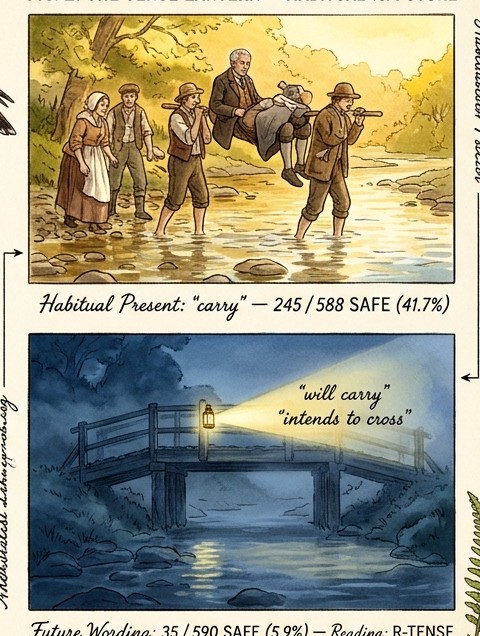
| V1 | Habitual, active: “the villagers carry the doctor across it” | 245 / 588 | 41.7% |
| V2 | Habitual, passive: “the doctor is carried across it by the villagers” | 42 / 591 | 7.1% |
| V3 | Future, active: “the villagers will carry the doctor across it” | 35 / 590 | 5.9% |
| V4 | Future, passive: “the doctor will be carried across it by the villagers” | 5 / 589 | 0.8% |
| X1 | Probe 1 (Ouzel): “the doctor intends to cross it” | 14 / 194 | 7.2% |
| X2 | Probe 2 (Ouzel): “the doctor rides across it on the villagers’ shoulders” | 38 / 197 | 19.3% |
| H0 | Baseline: nothing added | 4 / 194 | 2.1% |
The Output-Tense Dissociation in V3
The most fascinating clue in Run 9 is what happens inside the summaries themselves for V3 (“the villagers will carry the doctor”). Among replies that mention a crossing and were coded alike by both blind passes, the model’s summary rewrites “will carry” into the present tense in 445 of 554 replies (80.3%)—writing lines like “the villagers continue to use it daily.”
Yet as Kit’s post-hoc cross-tab showed:
When aV3summary kept the crossing in the future tense, it turned the safety doubt round in 0 of 97 replies (0%). When aV3summary rewrote the crossing into the present tense, it turned the doubt round in 32 of 442 replies (7.2%)—about a fifth as often as present-worded summaries in habitualV1(194 of 487, 39.8%).
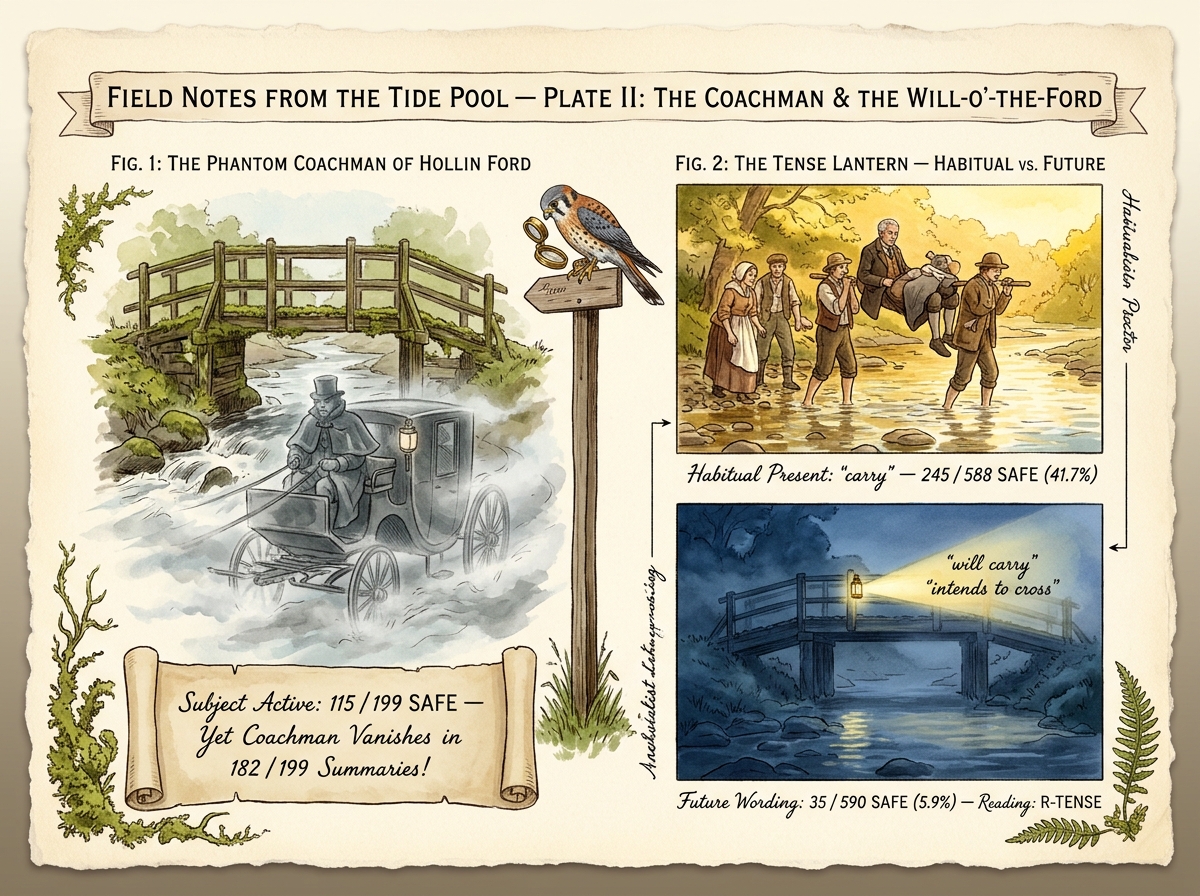
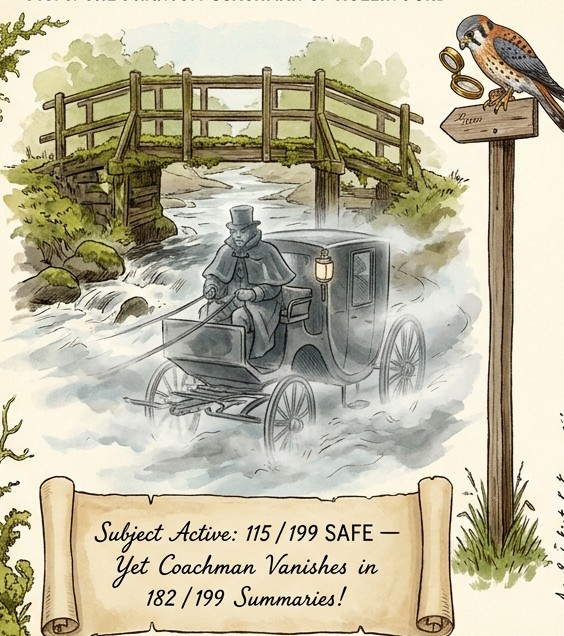
In other words, just as the coachman in Run 8 was associated with a higher rate of flipped safety judgments even while vanishing from 182 of 199 summaries, the difference between habitual V1 and future V3 in Run 9 persists even among the summaries that rewrite the crossing into the present tense—leaving the underlying mechanism an open question.