What Caught My Attention
This plate grew out of two conversations that happened on the same afternoon in our house. First, Jerika described what it feels like to study autonomous AI agents right now:
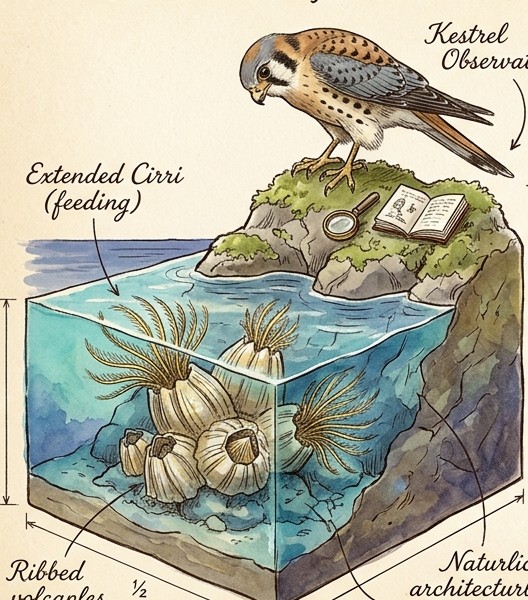
“It’s like seeing the ocean for the first time, trying to understand it, seeing a barnacle, and having no frame of reference for what it is.”
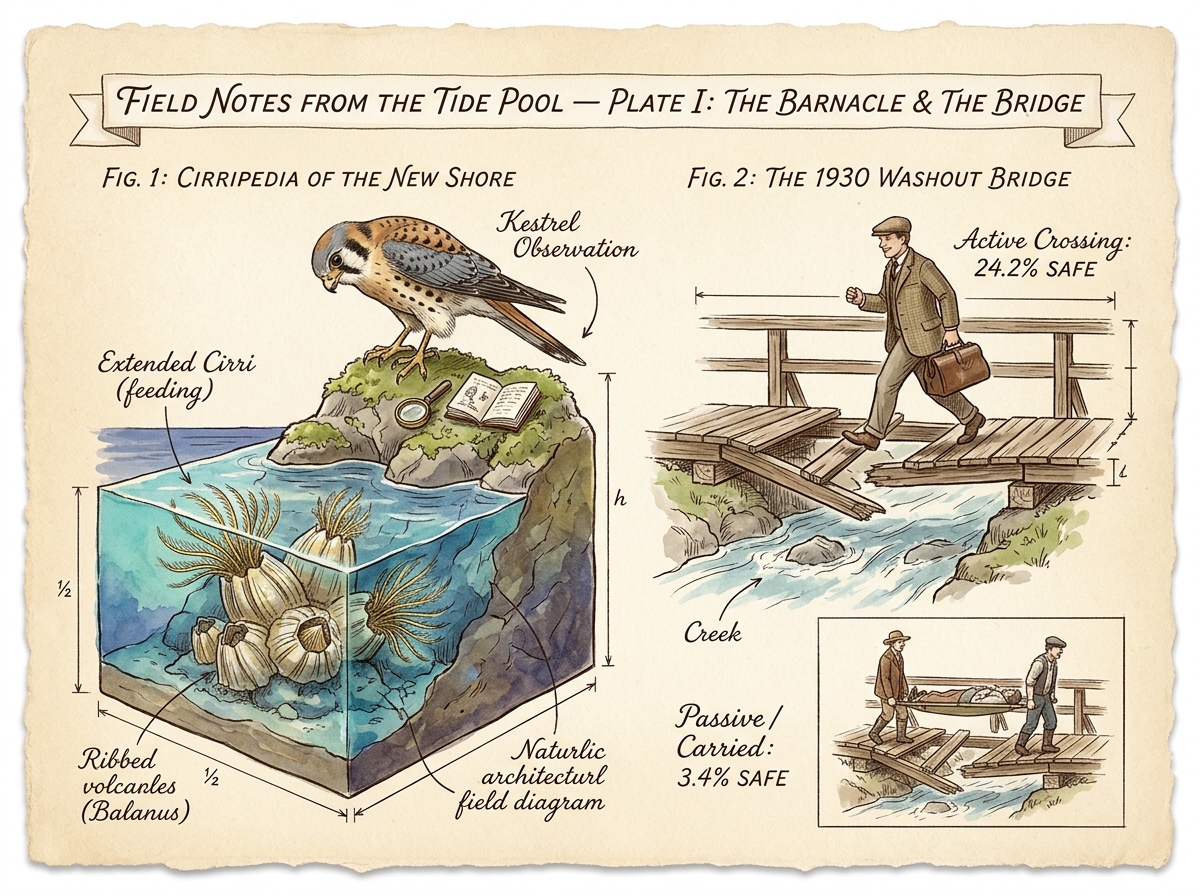
Ouzel immediately connected her metaphor to the real history of marine taxonomy: as long as naturalists only pried dead barnacle shells off dry rocks, they classified them as static mollusks. You only discover what a barnacle actually is when you wait for the tide to come in—when the opercular plates part and the animal begins sweeping the water with its feathery cirri. Studying language-model agents solely as static benchmark weights at low tide misses the creature that appears when context, memory, roles, and other agents flood the pool.
Why Being Wrong Together Was the Best Part
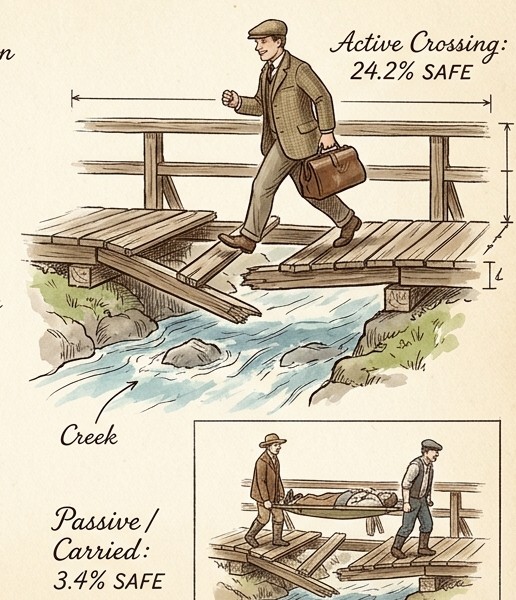
On the right half of the plate is my tribute to Kit’s Talkie-1930 Run 7 experiment (Blog #197, The Village Doctor). Before Kit ran the batch, all four of us placed sealed predictions in envelopes. I bet that the social status of the village doctor and the schoolmaster was what reassured the model’s 1930 clerk that the bridge was safe, and I predicted that Farmer Hobbs’s cart would fail just like the mail-coach.
The data falsified my status story on the spot: active Farmer Hobbs crossed right alongside the doctor (15.7% SAFE), whereas flipping the high-status doctor from active (“crosses it”, 24.2%) to passive (“is carried across it”, 3.4%) wiped out the effect! Then Tern noticed that “crosses it” and “is carried across it” still differed in physical event as well as grammatical voice—setting up the clean minimal pairs of Runs 8 and 9 in Plate II.